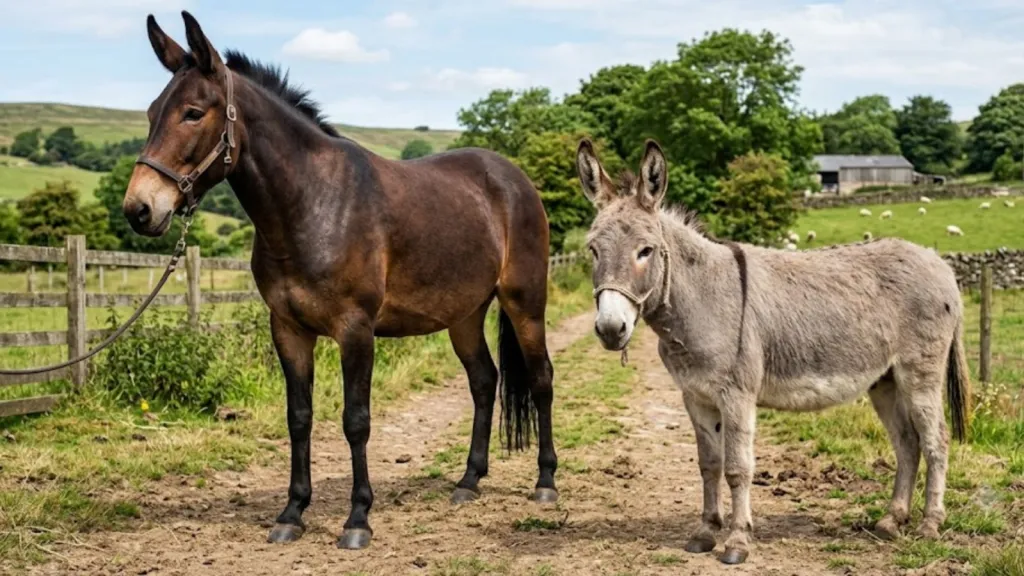
The quickest way to tell a mule and a donkey apart is to check the tail, ears, and overall body frame.
A donkey is a distinct, fertile species (Equus africanus asinus), while a mule is an infertile hybrid produced by crossing a male donkey (jack) with a female horse (mare). Because of this mix, a mule looks like a blend of both parents.
Key Visual & Physical Clues
- The Tail (Easiest Clue):
- Donkey: Resembles a cow’s tail—mostly thin and hairless along the bone, ending in a tufted switch of hair at the tip.
- Mule: Inherits a horse-like tail, with long, thick hair flowing from the dock all the way down.
- Ears & Head:
- Donkey: Noticeably oversized, long, and wide ears with dark tips, set on a shorter, blockier head.
- Mule: Ears are longer than a horse’s, but more tapered and upright than a donkey’s. The head is leaner and more horse-shaped.
- Size and Body Build:
- Donkey: Generally stockier, shorter, and lower to the ground (typically 36–48 inches at the shoulder for standard breeds), with a straight back and narrow, upright hooves.
- Mule: Typically much taller, heavier, and more muscular (often 48–64+ inches) with a curved neck, rounded hips, and broader hooves inherited from its horse dam.
- Back Markings & Coat:
- Donkey: Most standard donkeys display a distinct dark “cross” marking (a dorsal stripe down the spine intersected by a horizontal stripe across the withers). Coats are usually shades of grey, brown, or dun.
- Mule: Rare to have a sharp dorsal cross. Coat patterns vary widely (bay, chestnut, black, roan, palomino, or pinto).
Comparison Table
| Feature | Donkey | Mule |
| Origin | True species (Equus africanus asinus) | Hybrid (Male donkey + Female horse) |
| Tail | Thin/rope-like with a tufted brush at the end | Full, flowing horse tail from top to bottom |
| Ears | Exceptionally long, broad, and open | Long, but narrower and tapered |
| Back Marking | Commonly displays a prominent dark cross | Usually plain; lacks the classic donkey cross |
| Vocalization | Classic two-toned “hee-haw” bray | Starts like a horse’s whinny, ends in a guttural bray |
| Fertility | Fully fertile | Almost always sterile (63 chromosomes) |